Potato and onion bread: the recipe
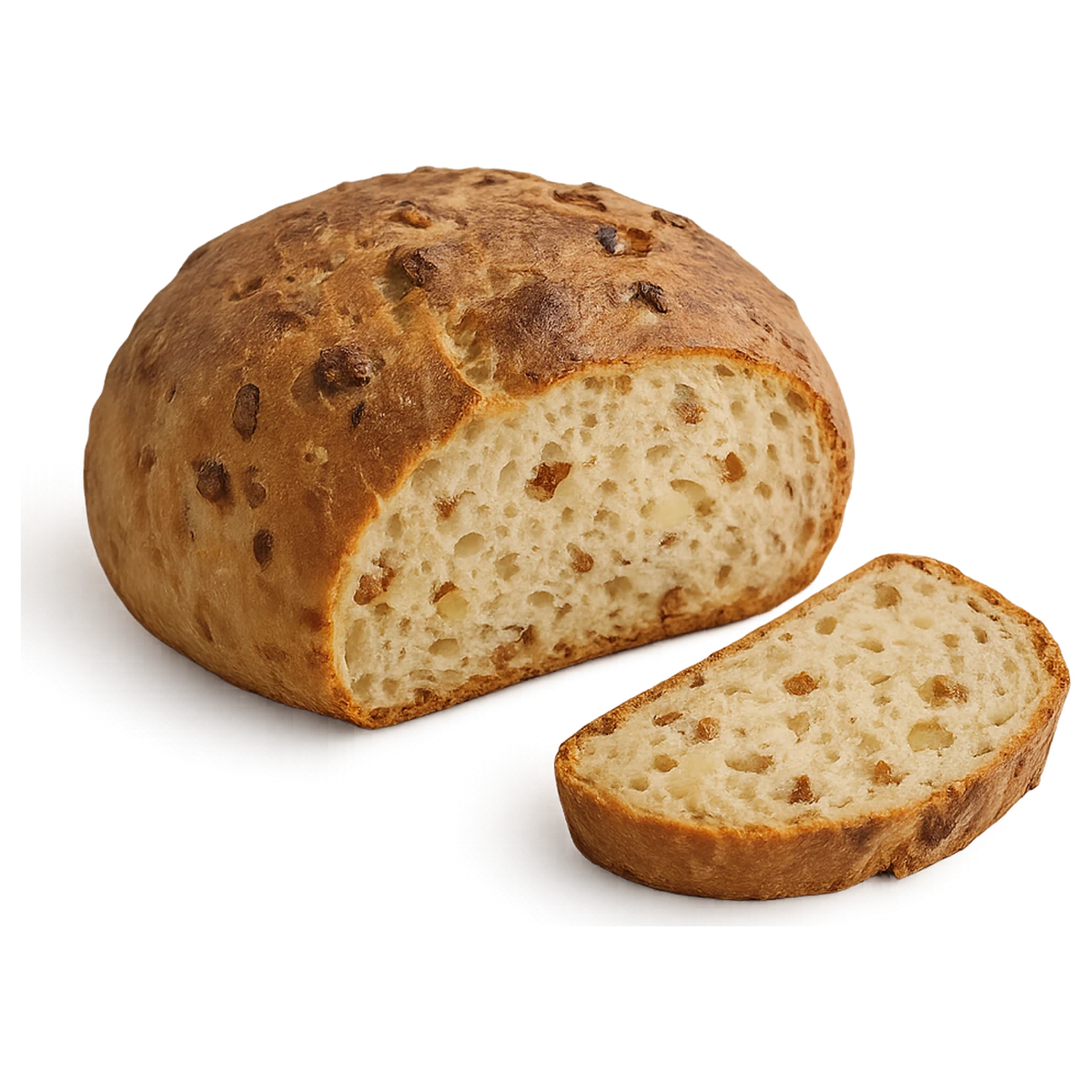
This rustic potato and onion bread was born out of necessity and went on to become a classic.
The recipe has deep historical roots in the 18th century, when severe famines in Europe pushed bakers to experiment with alternative ingredients (like barley, peas and potatoes) to feed the population. Of the various attempts, potato bread was the only one to gain lasting success.
Flavourful yellow-fleshed potatoes are ideal for this bread. Once cooked, cut the potatoes into small pieces with a knife or a bench scraper. Leaving the skin on shortens the preparation time and creates a pleasant colour contrast with the pale crumb once the bread is sliced. The result is an exceptionally soft, moist and flavourful loaf, with excellent keeping qualities.
As always, be sure to follow the instructions in the notes.
This recipe is freely inspired by, or adapted from, a formula by Master Jeffrey Hamelman.
At a glance
- Method: Preferment, without autolyse
- Preferment: Leftover dough — 30% of the flour
- Mixing: Stand mixer
- Number of pieces: 2
- Weight per piece: 680 g
- Preferment weight: 308 g
- Dough weight: 1048 g
- Total dough weight: 1360 g
Want to change the number of pieces, their weight or anything else? The calculator redoes the quantities. Open the calculator
Ingredients
Quantities for 2 pieces of 680 g, kitchen at 21 °C
Preferment
- Wheat flour (0, W320)184 g
- Water120 g
- Salt3.7 g (half a teaspoon)
- Yeast0.4 g
Dough
- Wheat flour (0, W320)338 g
- Wheat flour (Whole wheat, W290)92 g
- Water267 g
- Onions184 g
- Potatoes153 g
- Salt11 g
- Yeast3.4 g
Want to change the ingredients or use your own flour? The calculator redoes quantities and timing. Open the calculator
Method
- Pasta di riporto: make it and let it ferment (at room temperature) (14 hours)
- Weigh the ingredients
- Make a mix with 1 ice cube and 100 g of water at room temperature (to get it to 18 °C)
- Dissolve the yeast in the water
- Mix until you get a smooth dough
- Seal it airtight (a lid, or plastic wrap pressed onto the surface)
- Weigh the ingredients and knead (25 min)
- Use water at 24 °C
- End of mixing, start of bulk rise (at room temperature) (2 hours)Fold the dough once, after 1 hour of bulk fermentation.
- Reinforcement fold 1 of 3
- Reinforcement fold 2 of 3
- Reinforcement fold 3 of 3
- Divide/shape: weigh and form the pieces (5 min)
- Divide into 680 g (1.5 lb) pieces, preshape lightly into rounds and let rest covered with plastic for 10 to 20 minutes, until relaxed enough.
- Shape into round or oval loaves and place them into floured bannetons or between the folds of a floured linen couche, covered with plastic — or use a loaf pan.
- A distinctive cut for potato bread is the fendu: Press deep into the loaf lengthwise with a rolling pin, nearly bisecting it, and proof it upside down (cut side underneath).
- Start of proofing (at room temperature) (1 h 15 min)About 1¼ hours at 24 °C.
- Ready to cook
Want to change when you start or when you bake? The calculator gives you the schedule with exact times. Open the calculator
Baking
- conventional oven, with steam
- Overall temperature: 230 °C
- Time: 40 minutes
- Double steam (before loading and again right after). Once the loaves have taken on colour, open the vent to finish the bake drier — potatoes and onions bring a lot of colour to the crust, so lower the temperature by 5-10 °C if it's darkening too fast. A comparatively long bake, because of the moisture in the potatoes.
The calculator adapts baking times to the weight of your pieces. Open the calculator
Preparation notes
- Onions
- Slice them thin, toss with the least oil that still coats them well, put them in a covered pan (foil or lid) and roast at 180-205 °C, stirring now and then, until wilted and browned: They turn fragrant and sweet.
- Best done a day ahead, and in any case let them cool well before adding to the dough.
- Potatoes
- Cook them whole, skin on, in the oven or the microwave: That concentrates the flavour far more than boiling, where a good deal of it ends up in the cooking water.
- Peel them, mash or rice them, and let them cool before using: Hot potatoes risk killing the yeast.
Want to change something?
Open the calculator