Bagel: the recipe
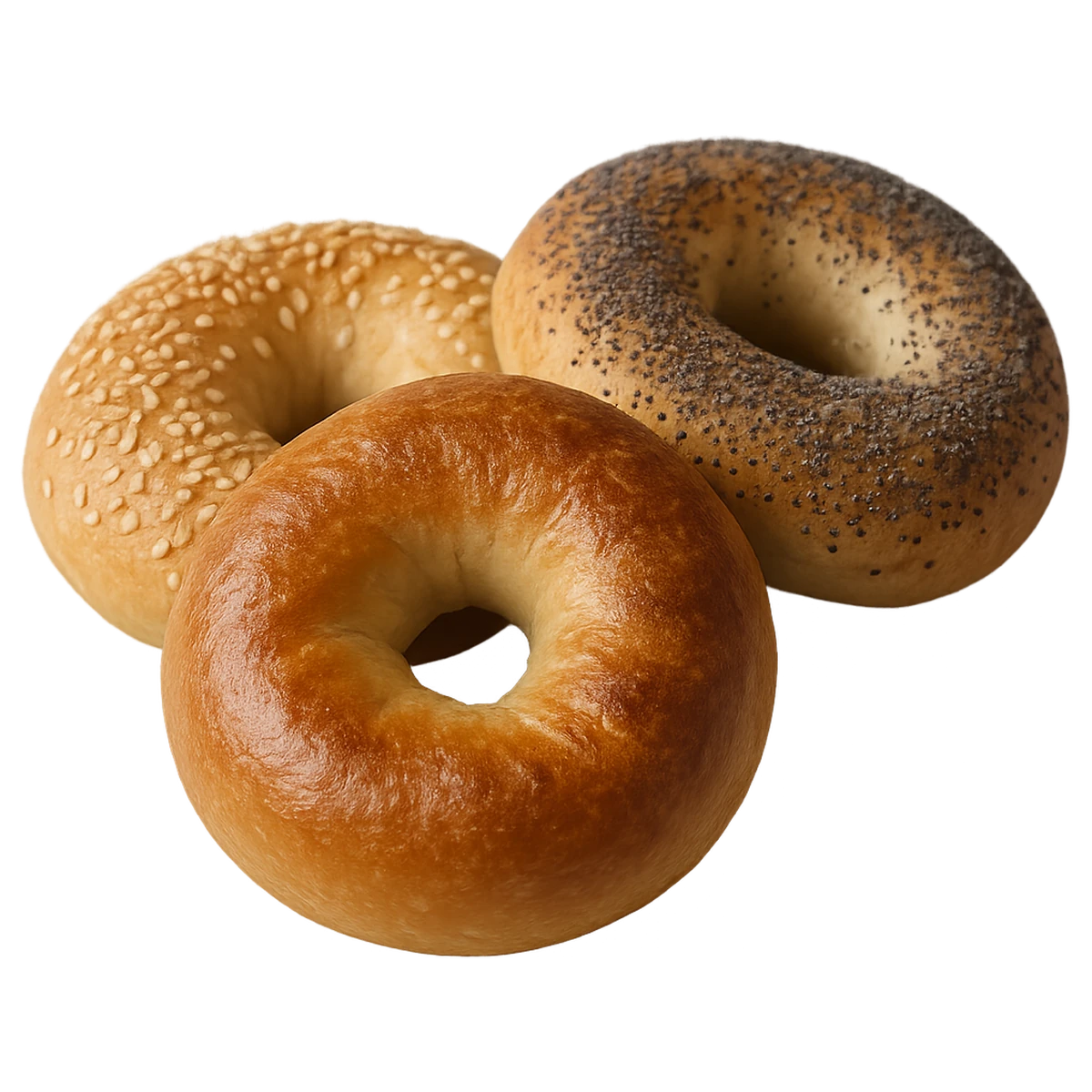
Bagel, a great classic of Polish baking.
This recipe lets you recreate real bagels at home, with their signature dense, chewy texture and glossy, taut crust. The process needs just a few specific steps, no special equipment required.
For the best result, the recipe calls for a strong flour. The dough follows the classic old-style formula, but if you prefer the profile of modern commercial bagels, you can add a small amount of sugar (2-3% of the flour weight) without affecting the workability of the structure.
What sets this recipe apart is the brief boil in water before baking, a step that gives the bagel its unique, unmistakable crust.
This recipe is freely inspired by, or adapted from, a formula by Master Jeffrey Hamelman.
At a glance
- Method: Preferment, without autolyse
- Preferment: Leftover dough — 20% of the flour
- Mixing: Stand mixer
- Number of pieces: 10
- Weight per piece: 115 g
- Preferment weight: 239 g
- Dough weight: 907 g
- Total dough weight: 1150 g
Want to change the number of pieces, their weight or anything else? The calculator redoes the quantities. Open the calculator
Ingredients
Quantities for 10 pieces of 115 g, kitchen at 21 °C
Preferment
- Wheat flour (0, W350)143 g
- Water93 g
- Salt2.9 g (half a teaspoon)
- Yeast0.3 g
Dough
- Wheat flour (0, W350)570 g
- Water321 g
- Salt11 g
- Yeast4.2 g
Want to change the ingredients or use your own flour? The calculator redoes quantities and timing. Open the calculator
Method
- Pasta di riporto: make it and let it ferment (at room temperature) (14 hours)
- Weigh the ingredients
- Make a mix with 1 ice cube and 73 g of water at room temperature (to get it to 18 °C)
- Dissolve the yeast in the water
- Mix until you get a smooth dough
- Seal it airtight (a lid, or plastic wrap pressed onto the surface)
Let it mature 12-16 hours at 21 °C (70 °F). - Weigh the ingredients and knead (20 min)
- Use water at 24 °C
Knead the pâte fermentée (torn into pieces) together with all the final dough ingredients: The dough will be stiff, low in hydration. - End of mixing, start of bulk rise (at room temperature) (1 hour)
- Divide/shape: weigh and form the pieces (15 min)Divide into 115 g pieces that are more or less square. Flatten them and roll each one into a tight cylinder 25 to 28 cm (10 to 11 inches) long, with no taper at the ends. Wrap it around the broadest part of your hand, overlapping the two ends slightly on your palm, and roll your hand back and forth on the bench to seal them together. Place the shaped bagels on sheet pans sprinkled with cornmeal or semolina.
- Start of proofing (in the fridge) (6 hours)Cover with plastic and refrigerate for at least 6 hours, or overnight.
- Boiling (at room temperature) (10 min)Bring a large pot of water to the boil with the recipe's diastatic malt powder dissolved in it (optionally malt syrup or honey too: They give color and shine in the oven, and reactivate yeast that's sluggish from the cold). Drop the bagels in straight from the fridge, without crowding the pot, until puffy: 1 to 2 minutes, flipping halfway. Longer boiling makes them less chewy. Drain briefly on a cooling rack.
- Ready to cookIf you like, press one side of the drained bagels into sesame or poppy seeds (not counted in the dough). Place them on parchment paper or a silicone baking mat, good side down. Bake at 260 °C (500 °F), turning them over halfway through so the good side finishes on top. Time depends on your oven and how dark you like them.
Want to change when you start or when you bake? The calculator gives you the schedule with exact times. Open the calculator
Want to change something?
Open the calculator