Multigrain whole wheat bread: the recipe
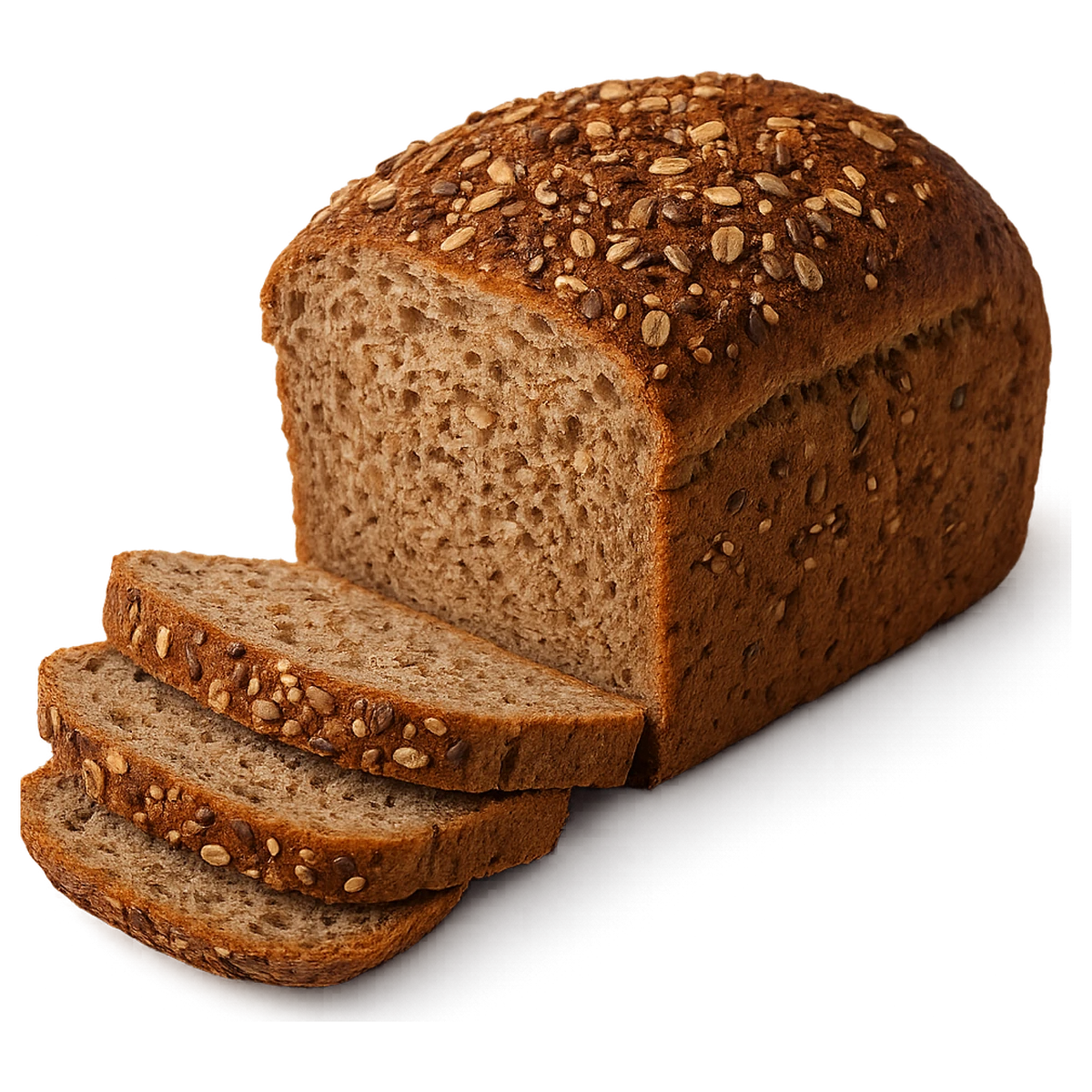
This is a bread with a bold, hearty character that keeps well thanks to its high moisture content.
Flavour and lift: pre-fermenting 35% of the flour gives the dough remarkable rising strength and deep aromatic complexity.
Lasting softness: soaking the grains holds water in the dough, giving a moist crumb that stays fresh for days.
Just the right balance: the apparently generous amount of salt is calibrated to properly season the soaked grains too.
Fully customisable: you can enrich or replace the base with flax, sesame, sunflower seeds or cracked rye to taste.
This recipe is freely inspired by, or adapted from, a formula by Master Jeffrey Hamelman.
At a glance
- Method: Preferment, without autolyse
- Preferment: Leftover dough — 35% of the flour
- Mixing: Stand mixer
- Number of pieces: 2
- Weight per piece: 680 g
- Preferment weight: 385 g
- Dough weight: 971 g
- Total dough weight: 1360 g
Want to change the number of pieces, their weight or anything else? The calculator redoes the quantities. Open the calculator
Ingredients
Quantities for 2 pieces of 680 g, kitchen at 21 °C
Preferment
- Wheat flour (0, W320)230 g
- Water150 g
- Salt4.6 g (a teaspoon)
- Yeast0.5 g
Dough
- Wheat flour (Whole wheat, W290)329 g
- Wheat flour (0, W320)99 g
- Water199 g
- Soaking water165 g
- Salt11 g
- Honey33 g
- Cracked wheat33 g
- Coarse cornmeal33 g
- Millet33 g
- Rolled oats33 g
- Yeast3.6 g
Want to change the ingredients or use your own flour? The calculator redoes quantities and timing. Open the calculator
Method
- Prepare the grains (see notes)
- Pasta di riporto: make it and let it ferment (at room temperature) (14 hours)
- Weigh the ingredients
- Make a mix with 1 ice cube and 130 g of water at room temperature (to get it to 18 °C)
- Dissolve the yeast in the water
- Mix until you get a smooth dough
- Seal it airtight (a lid, or plastic wrap pressed onto the surface)
- Weigh the ingredients and knead (35 min)
- Use water at 24 °C
- Add the pâte fermentée last.
- Soakers absorb water unevenly: If the dough seems too dry, don't hesitate to add more water.
- End of mixing, start of bulk rise (at room temperature) (2 hours)
- Reinforcement fold 1 of 3
- Reinforcement fold 2 of 3
- Reinforcement fold 3 of 3
- Divide/shape: weigh and form the pieces (5 min)
- Divide into 680 g (1.5 lb) pieces, preshape lightly into rounds and place on a lightly floured work surface, covered with plastic.
- When the dough has relaxed sufficiently (10 to 15 minutes), shape into round or oval loaves and place them into floured bannetons or between the folds of a floured linen couche, covered with plastic.
- It can also be put in loaf pans or shaped into rolls.
- Start of proofing (at room temperature) (1 h 15 min)
- Ready to cookSlash the loaves as desired before loading the oven.
Want to change when you start or when you bake? The calculator gives you the schedule with exact times. Open the calculator
Baking
- conventional oven, with steam
- Overall temperature: 230 °C
- Time: 40 minutes
- Double steam (before loading and again right after). Once the loaves have taken on colour, open the vent to finish the bake drier — the honey brings a lot of colour to the crust, so lower the temperature by 5-10 °C if it's darkening too fast.
The calculator adapts baking times to the weight of your pieces. Open the calculator
Preparation notes
- Soaker
- Put the cracked wheat, coarse cornmeal, millet and oats from the ingredient list in a bowl. Pour the boiling water over them, stir to incorporate and cover with plastic wrap.
- Make it together with the pâte fermentée: It only needs 4 hours before mixing, but it can sit for as long as the pâte fermentée matures without issues. In hot weather, you can put part of the recipe's salt in the soaker: It slows down the enzymatic activity of the raw grains.
- For a finer crumb, break up the hardest grains first (millet especially) in a spice grinder or food processor, then pour the water over them.
- Bassinage
- If mixing with a stand mixer or spiral mixer, pour in the last 20% of the water gradually, in a thin stream, only after the gluten network has formed.
Want to change something?
Open the calculator