Rosetta rolls: the recipe
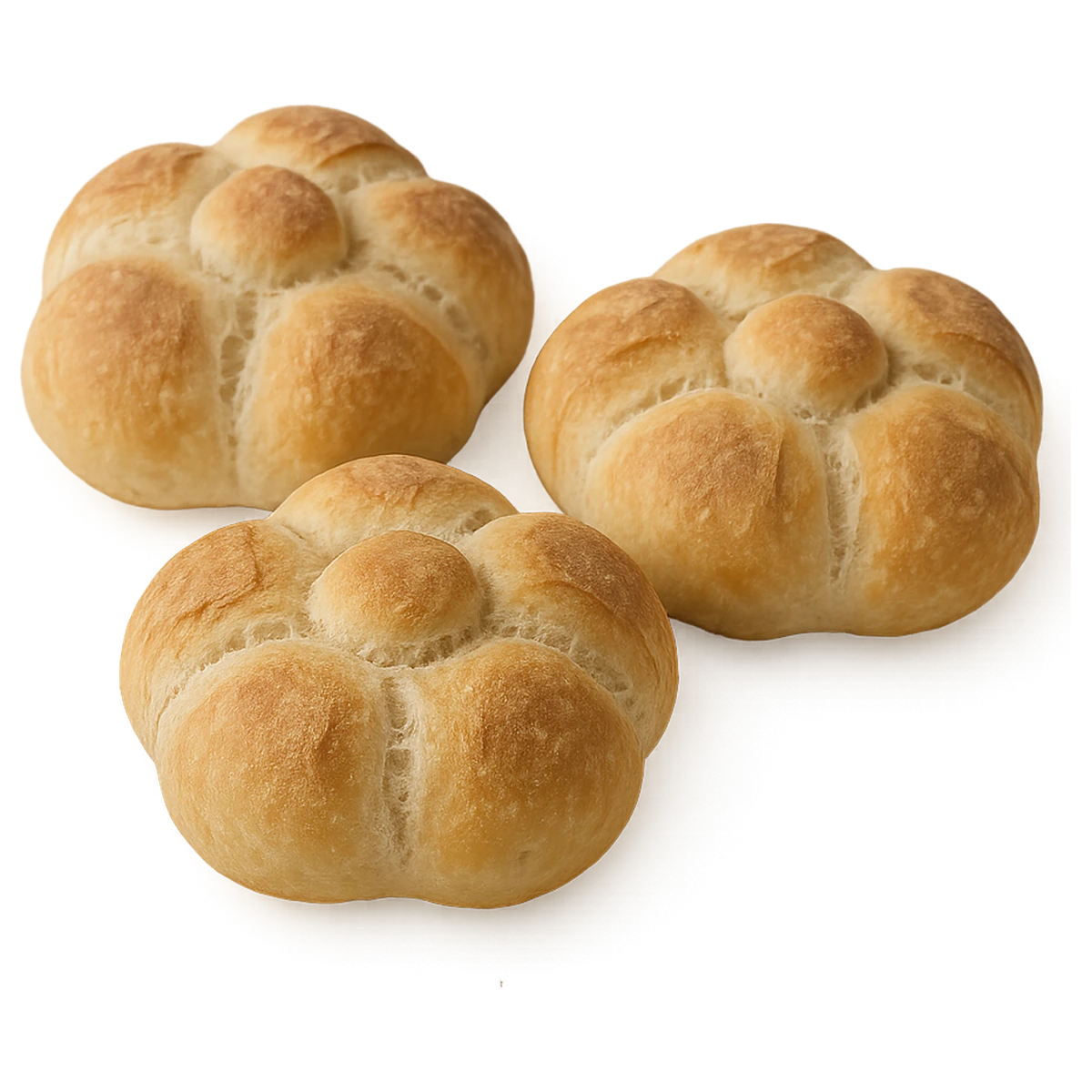
Puffed rosetta rolls are a symbol of bread baking in Lazio: round rolls, completely hollow inside, with a five-petal crust plus a small "cap".
The crust is crystalline, wafer-thin, golden and very crisp, shattering with the characteristic crackle at the first bite. The crumb is almost non-existent; the rosetta is, after all, "puffed" — entirely hollow inside. Only a few light, airy strands of crumb remain, created by the steam that puffs up the dough during baking.
This bread is marked by a substantial biga relative to the final dough, a very stiff, dry final dough, and a distinctive technique: the dough is laminated in a sheet before being divided, then stamped into its five-petal shape. As always, be sure to follow the instructions in the notes.
At a glance
- Method: Preferment, without autolyse
- Preferment: Biga — 70% of the flour
- Mixing: Spiral mixer
- Number of pieces: 10
- Weight per piece: 110 g
- Preferment weight: 750 g
- Dough weight: 353 g
- Total dough weight: 1100 g
Want to change the number of pieces, their weight or anything else? The calculator redoes the quantities. Open the calculator
Ingredients
Quantities for 10 pieces of 110 g, kitchen at 20 °C
Preferment
- Wheat flour (W365)514 g
- Water231 g
- Yeast5.2 g
Dough
- Wheat flour (W260)220 g
- Water112 g
- Salt8.4 g (a teaspoon and a half)
- Mixed seed oil4.4 g (a teaspoon)
- Barley malt5.2 g (a teaspoon and a half)
- Yeast1.8 g
Want to change the ingredients or use your own flour? The calculator redoes quantities and timing. Open the calculator
Method
- Biga: make it and let it ferment (at room temperature) (16 hours)
- Weigh the ingredients
- Make a mix with 2 ice cubes and 191 g of water at room temperature (to get it to 11 °C)
- Dissolve the yeast in the water
- Mix roughly
- Transfer to a container, covered but not airtight
- Weigh the ingredients and knead (25 min)
- Use water at 31 °C
- End of mixing, start of bulk rise (at room temperature) (15 min)
- Divide/shape: weigh and form the pieces (15 min)
- Before dividing, pass the dough repeatedly through the sheeter rollers (or roll it out thinly with a pin/dough sheeter) and fold it back on itself, for 8-10 passes: that's what gives the rosetta its structure.
- Lightly brush the laminated sheet with oil (not counted in the dough, used raw).
- Divide into pieces and round them into very tight, taut balls: the tighter the ball, the better it holds the stamped shape.
- Start of proofing (at room temperature) (40 min)Let the balls rest covered for 40 minutes, with no further handling.
- Continue proofing (at room temperature) (50 min)
- Take the star-shaped stamp and cut into the ball almost all the way through, leaving just a few millimetres at the base: A clean, deep cut creates the five petals.
- Right after, flip the rosetta upside down onto a floured cloth: Let it rest like that, covered, for 45-60 minutes.
- Stabilizzazione in frigo (in the fridge) (25 min)
- A short spell in the fridge (20-30 minutes at 4-6 °C) stabilises the roll's structure: The chill firms up the outer skin slightly, so that when it hits the hot oven the thermal shock pushes the internal steam harder before the crust turns too pliable.
- Right before baking, flip the rosette rolls right side up again.
- Ready to cook
Want to change when you start or when you bake? The calculator gives you the schedule with exact times. Open the calculator
Baking
- fan-assisted oven, with steam
- Overall temperature: 240 °C
- Time: 5 minutes
- Low in the oven but not on the floor, massive initial steam burst
- fan-assisted oven, with steam
- Overall temperature: 230 °C
- Time: 9 minutes
- Continue baking, steam still on
- fan-assisted oven, without steam
- Overall temperature: 200 °C
- Time: 4 minutes
- Open the vent (or leave the oven door slightly ajar) to let the remaining moisture out and crystallise the crust
The calculator adapts baking times to the weight of your pieces. Open the calculator
Preparation notes
- The point of the biga
- How ripe the biga is decides everything: Too young and the roll barely develops; too ripe or sour and the gluten network gives way, the gases escape and the roll comes out solid.
- A biga wants 16-20 °C. If your kitchen is warmer, look for the coolest spot you have — a cellar, a pantry, the north-facing room.
- In the fridge a biga matures but does not rise, and adding yeast does not make up for the cold: It just sits there and then takes off all at once in the final dough. If you have no alternative, split the biga into two stages — a couple of hours at room temperature to get it going, then the fridge — adding them from the times table.
- The dough
- Close the dough stiff and dry: with hydration this low (50-52%), don't expect the elastic development of a normal dough — that's intentional, it's that stiffness that lets it withstand lamination without collapsing.
Want to change something?
Open the calculator