Challah: the recipe
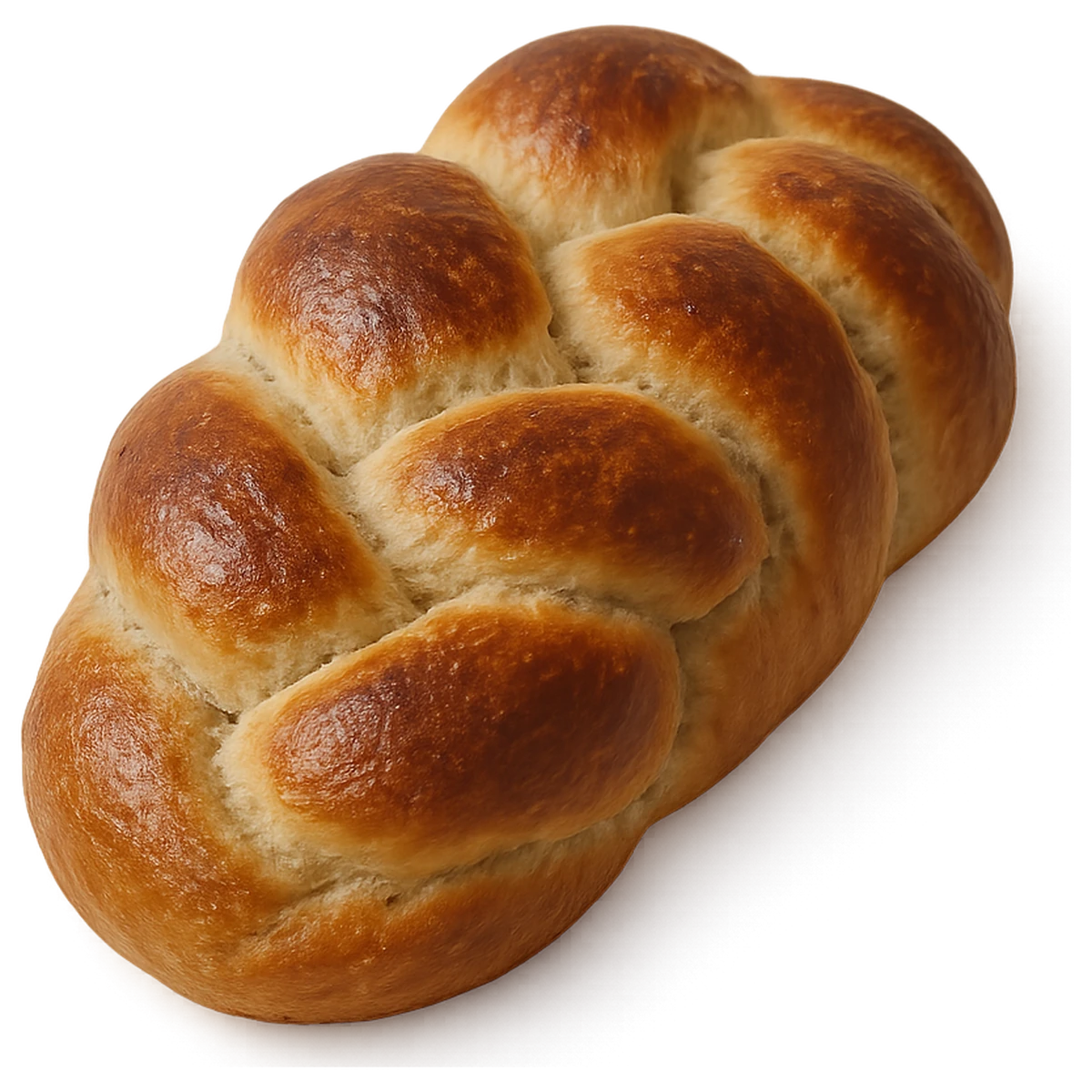
Bring the magic of Shabbat to the table.
Challah is the famous braided egg bread of Jewish tradition, known the world over for its extraordinary softness and the beauty of its shapes.
The richness of its dough, built on eggs and oil (strictly no dairy), makes it as soft as a cloud and perfect for keeping for days.
Whether you braid it for holidays or dress it up with sesame and poppy seeds, its lightly sweet flavour will win you over. Leftovers become the ideal base for a jaw-dropping French toast.
This recipe is freely inspired by, or adapted from, a formula by Master Jeffrey Hamelman.
At a glance
- Method: Straight dough, without autolyse
- Mixing: Stand mixer
- Number of pieces: 3
- Weight per piece: 510 g
- Dough weight: 1513 g
- Total dough weight: 1530 g
Want to change the number of pieces, their weight or anything else? The calculator redoes the quantities. Open the calculator
Ingredients
Quantities for 3 pieces of 510 g, kitchen at 20 °C
- Wheat flour (0, W220)870 g
- Egg yolks80 g (4 pcs)
- Eggs110 g (2 pcs)
- Water278 g
- Salt17 g
- Mixed seed oil65 g
- Sugar87 g
- Yeast5.7 g
Want to change the ingredients or use your own flour? The calculator redoes quantities and timing. Open the calculator
Method
- Weigh the ingredients and knead (25 min)
- Use water at 23 °C
Mix all the ingredients except the salt until the gluten develops, then add the salt and continue to a fairly strong gluten development: A dough this enriched (sugar, eggs, oil) comes off the mixer already strong on its own, no real reinforcement fold is needed afterwards. - End of mixing, start of bulk rise (at room temperature) (2 hours)
- Degas the dough once, after the first hour of bulk fermentation, by gently pressing out the gas.
- As an alternative to the two hours at room temperature, the dough can retard overnight in the fridge: Lower the desired dough temperature to 24 °C, degas it after 1 hour and refrigerate it covered, degassing it a couple more times over the following hours. You can divide and shape the braids straight from the fridge, or — once the dough is cold — divide it into strands, cover them and keep them in the fridge until ready to braid (but not more than 24 hours after mixing).
- Divide/shape: weigh and form the pieces (5 min)
- Divide the dough into as many pieces as you like. Preshape lightly into rounds or blunt cylinders and let rest on an unfloured surface, covered with plastic. Once relaxed enough to be elongated without tearing (10 to 15 minutes), roll out the strands and braid them.
- Once braided, cover the loaves with baker's linen and a sheet of plastic to keep a skin from forming. If using a proof box with humidity, keep it low: Too much humidity makes the strands merge together.
- Start of proofing (at room temperature) (1 h 45 min)About 1h30 to 2 hours at 24 °C.
- Ready to cookEgg wash the surface well (not counted in the dough); sprinkle with poppy or sesame seeds if you like. Baking time depends on the size of the braids; pan loaves take longer than freestanding ones.
Want to change when you start or when you bake? The calculator gives you the schedule with exact times. Open the calculator
Baking
- conventional oven, without steam
- Overall temperature: 193 °C
- Time: 30 minutes
- No steam. Time calculated for 510 g (18 oz) braids: Larger loaves or pan loaves take longer.
The calculator adapts baking times to the weight of your pieces. Open the calculator
Want to change something?
Open the calculator